Showing posts with label Lanner. Show all posts
Showing posts with label Lanner. Show all posts
Saturday, January 21, 2017
Michael Pamer, Neue brillante Ländler (1827)
I have published two posts on Michael Pamer's Neue brillante Ländler (12 volumes, 1827): link to the first post. Pamer is widely regarded as the skilled musician who brought the style of the "Linzer Geiger" into dance halls and house balls, though it was his protegés, Lanner and Johann Strauss, sr., who became famous for it.

Sunday, December 12, 2010
Eric McKee's presentation in Indianapolis
Eric McKee (Pennsylvania State University) and I proposed a short session for last month's AMS/SMT joint meeting in Indianapolis. The SMT program committee accepted both papers but rejected the session: worse, from our point of view, we ended up cross-scheduled!
Eric has kindly allowed me to post his original proposal here; its title is "Lanner and Strauss and "The Future of Rhythm."
Wildly successful, Joseph Lanner and Johann Strauss I are among the first generation of musicians who devoted themselves solely to the composition, performance, and publication of music aimed at a wide audience and designed for showmanship, pleasure, and dancing--music referred to today as "popular music." During the late 1820s and early 1830s Lanner and Strauss refined the characteristic features of the Viennese waltz, which is arguably the most important and certainly the longest living dance genre in the history of Western music. Composers such as Mendelssohn, Wagner, and Berlioz, among others, heaped praise on Lanner and Strauss both for the high level of their orchestral performances as well as their melodic ingenuity. Even the conservative critic Hanslick was not immune from the charms of their music. But despite the historical significance and far-reaching influence of their music, there has been only one published analytical study in English devoted to this vast repertoire of music (Yaraman 2002).
My presentation begins with a discussion of Berlioz's 1837 article "Strauss: His Orchestra, His Waltzes--The Future of Rhythm." In it Berlioz laments the primitive state of rhythmic understanding, especially in France, and advocates treating rhythm as an independent dimension just as important to musical interest as melody and harmony. He observes that "the combinations in the realm of rhythm must certainly be as numerous as melodic ones, and the links between them could be made as interesting as for melody. Nothing can be more obvious than that there are rhythmic dissonances, rhythmic consonances, and rhythmic modulations" (Quoted in Barzun 1969: Volume II, 338 [italics in original]). The true pioneers in this field, he continues, are Germans: Gluck, Beethoven, Weber--and Strauss. Speaking specifically of Strauss's waltzes, Berlioz locates one source of rhythmic dissonance in the cross rhythms found between the melody and accompaniment.
In the remainder of my presentation I continue Berlioz's line of thought by examining two techniques used by Lanner and Strauss that result in rhythmic dissonances: melodic hemiolas and extended anacruses. My methodology is based on the work of Rothstein (1989), Krebs (1999), and McKee (2004). The repertoire I examine are waltzes composed between 1826 and 1836, which constitute the first ten years of Lanner and Strauss's published output.
Melodies that form hemiolic patterns against the accompaniment are the most characteristically "Viennese" type of rhythmic dissonance (Krebs classifies this type of texture as a "G3/2 dissonance" [1999: 31-34]). In terms of our real time perception and the relationship of the music to the physical gestures of the dance, however, the primary level of the accompaniment is more easily heard and felt in 6/4 rather than in the notated 3/4. Playing against the accompaniment's 6/4, the melodies project their own 3/2 grouping patterns. Example 1 provides some examples. (This is a thumbnail; click on the image to see the original size.)
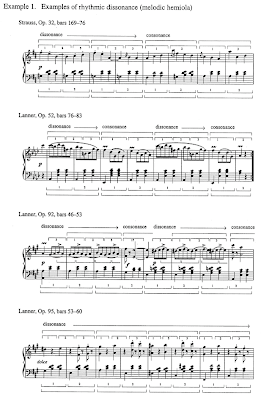
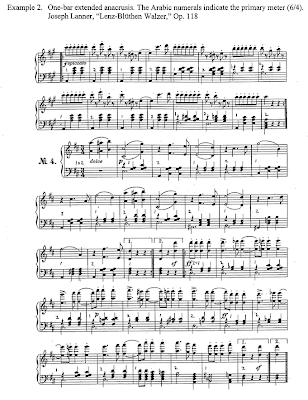
As seen in the first three melodies, a common maneuver employed by Lanner and Strauss is the progression from rhythmic dissonance to rhythmic consonance within an eight-bar phrase or within a four-bar subphrase. In other cases the hemiolic patterns are displaced so as not to begin on the downbeats of the accompaniment's 6/4 meter (Example 2).
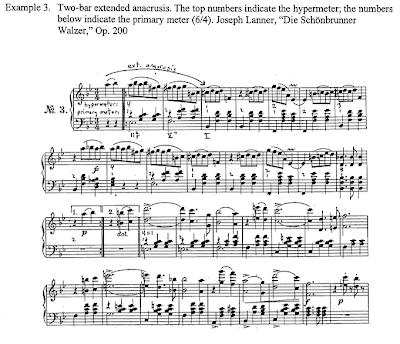
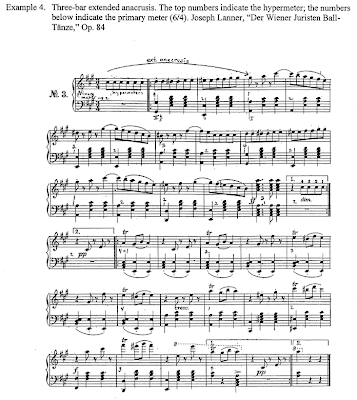
Extended anacruses are another potential source of dissonance (or disruption). They typically arise from the noncongruence between the melodic grouping structure, and they typically are associated with a disruption in the hypermetric flow (Examples 3-4). My paper concludes with some general considerations on the expressive, formal, and choreographical implications of such rhythmic and metrical dissonances.
References:
Berlioz, Hector. 2001. Critique Musicale: 1823-1863. Ed. Yves Gerard. Paris: Buchet/Chastel.
Krebs, Harald. 1999. Fantasy Pieces: Metrical Dissonances in the Music of Robert Schumann. New York: Oxford University Press.
McKee, Eric. 2004. "Extended Anacruses in Mozart's Instrumental Music. Theory and Practice 29: 1-38.
Rothstein, William. 1989. Phrase Rhythm in Tonal Music. New York: Schirmer Books.
Yaraman, Sevin. 2002. Revolving Embrace: The Waltz as Sex, Steps, and Sound. Hillsdale, NY: Pendragon Press.
Eric has kindly allowed me to post his original proposal here; its title is "Lanner and Strauss and "The Future of Rhythm."
Wildly successful, Joseph Lanner and Johann Strauss I are among the first generation of musicians who devoted themselves solely to the composition, performance, and publication of music aimed at a wide audience and designed for showmanship, pleasure, and dancing--music referred to today as "popular music." During the late 1820s and early 1830s Lanner and Strauss refined the characteristic features of the Viennese waltz, which is arguably the most important and certainly the longest living dance genre in the history of Western music. Composers such as Mendelssohn, Wagner, and Berlioz, among others, heaped praise on Lanner and Strauss both for the high level of their orchestral performances as well as their melodic ingenuity. Even the conservative critic Hanslick was not immune from the charms of their music. But despite the historical significance and far-reaching influence of their music, there has been only one published analytical study in English devoted to this vast repertoire of music (Yaraman 2002).
My presentation begins with a discussion of Berlioz's 1837 article "Strauss: His Orchestra, His Waltzes--The Future of Rhythm." In it Berlioz laments the primitive state of rhythmic understanding, especially in France, and advocates treating rhythm as an independent dimension just as important to musical interest as melody and harmony. He observes that "the combinations in the realm of rhythm must certainly be as numerous as melodic ones, and the links between them could be made as interesting as for melody. Nothing can be more obvious than that there are rhythmic dissonances, rhythmic consonances, and rhythmic modulations" (Quoted in Barzun 1969: Volume II, 338 [italics in original]). The true pioneers in this field, he continues, are Germans: Gluck, Beethoven, Weber--and Strauss. Speaking specifically of Strauss's waltzes, Berlioz locates one source of rhythmic dissonance in the cross rhythms found between the melody and accompaniment.
In the remainder of my presentation I continue Berlioz's line of thought by examining two techniques used by Lanner and Strauss that result in rhythmic dissonances: melodic hemiolas and extended anacruses. My methodology is based on the work of Rothstein (1989), Krebs (1999), and McKee (2004). The repertoire I examine are waltzes composed between 1826 and 1836, which constitute the first ten years of Lanner and Strauss's published output.
Melodies that form hemiolic patterns against the accompaniment are the most characteristically "Viennese" type of rhythmic dissonance (Krebs classifies this type of texture as a "G3/2 dissonance" [1999: 31-34]). In terms of our real time perception and the relationship of the music to the physical gestures of the dance, however, the primary level of the accompaniment is more easily heard and felt in 6/4 rather than in the notated 3/4. Playing against the accompaniment's 6/4, the melodies project their own 3/2 grouping patterns. Example 1 provides some examples. (This is a thumbnail; click on the image to see the original size.)

As seen in the first three melodies, a common maneuver employed by Lanner and Strauss is the progression from rhythmic dissonance to rhythmic consonance within an eight-bar phrase or within a four-bar subphrase. In other cases the hemiolic patterns are displaced so as not to begin on the downbeats of the accompaniment's 6/4 meter (Example 2).

Extended anacruses are another potential source of dissonance (or disruption). They typically arise from the noncongruence between the melodic grouping structure, and they typically are associated with a disruption in the hypermetric flow (Examples 3-4). My paper concludes with some general considerations on the expressive, formal, and choreographical implications of such rhythmic and metrical dissonances.


References:
Berlioz, Hector. 2001. Critique Musicale: 1823-1863. Ed. Yves Gerard. Paris: Buchet/Chastel.
Krebs, Harald. 1999. Fantasy Pieces: Metrical Dissonances in the Music of Robert Schumann. New York: Oxford University Press.
McKee, Eric. 2004. "Extended Anacruses in Mozart's Instrumental Music. Theory and Practice 29: 1-38.
Rothstein, William. 1989. Phrase Rhythm in Tonal Music. New York: Schirmer Books.
Yaraman, Sevin. 2002. Revolving Embrace: The Waltz as Sex, Steps, and Sound. Hillsdale, NY: Pendragon Press.
Tuesday, January 5, 2010
Postscript to Dance in Vienna
This is a postscript to Part 1 of the historical series completed yesterday. This was originally a very long footnote to the first sentence: “What Schubert found when he began composing waltzes about 1812 was not a simple, innocent country dance, as it is sometimes portrayed in an attempt to put as much distance between mass art and high art as possible.”
The literature has many examples of the damage done to style studies of nineteenth century and twentieth century music when mass art is ignored, but Leonard Meyer offers a particularly egregious instance that makes the point with unusual clarity. Meyer examines "the fortunes of the cadential 6/4 progression[,] tracing its rise and demise" (250). In the course of this, he points to the familiar notion of Romantic ideology as favoring the anti-conventional, and thus he says, quite plausibly, that Romantic values, which favored endings that are "gradual, continuous, and open," militate against such a clichéd and emphatic ending gesture as the cadential 6/4:
The very sonic salience that made the cadential 6/4 progression such a forceful signal made it seem routine and commonplace–a bit blatant. This is one reason why, as the years passed, the cadential 6/4 progression was less and less frequently chosen by composers (248).
Meyer's statistics come from pieces included in The Norton Scores anthology (a pedagogical collection), and his conclusions, although broadly correct for the repertoires involved (if one ignores Brahms and Bizet), are nevertheless useless as generalizations about all the musics of the period concerned. Meyer claims that, by the last quarter of the nineteenth century, "[t]he cadential 6/4 progression . . . continued to be used in popular music and in the music of somewhat conventional composers" (250). It was employed "by composers of a more adventurous kind" only for special purposes.
It is true that Johann Strauss, jr., for one, was quite fond of the cadential 6/4 (and often displayed it prominently, stretched over several bars): my own quick survey shows that the ten strains in five waltzes use this chord 4, 8, and 6 times, respectively, in opuses 314, 325, and 340. Schubert, on the other hand, rarely used it in his dances: for example, in the waltzes of D. 779, nine times in 68 strains; in D. 681, only once in 16 strains; in the ecossaises of D. 421, 511, and 529 combined, ten times in 30 strains; in D. 781, three times in 22 strains. Johann Strauss, sr., was equally disdainful of the cadential 6/4: there are twelve appearances in the forty strains of opuses 201, 213, 218, and 230, combined. Josef Lanner was even more parsimonious: six appearances in sixty strains for the five opuses 19, 20, 40, 42, and 46.
Thus the dance repertoire completely upends Meyer's claim: in fact, the Romantic "extinction" of the 6/4 had already occurred in this popular music by the early 1820s. The chord had to be restored in the music of the mid-century, in the case of the younger Strauss, probably because of the space provided by longer sixteen and thirty-two bar strains, but equally also because of the greater volume and dramatic effect, useful in music for the larger orchestras and venues for which Strauss normally composed.
Reference:
Meyer, Leonard B. The Spheres of Music: A Gathering of Essays. Chicago: University of Chicago Press, 2000.
Sunday, January 3, 2010
Dance in Vienna circa 1820, part 3
Schubert's dance compositions circulated in copies he himself made for friends (Brown, 218), and collections of his dances were published as early as 1821. He also contributed dances to "special Carnival anthologies every year from 1822 through 1828" (Hanson 155). Apart from three sets of dances for four-part strings, written in 1813-1814, Schubert left no orchestral arrangements of his dances, but the evidence that arrangements of his dances were made by others for a public casino ball in Linz in 1826 (Litschauer, 248) suggests that it is by no means impossible his waltzes and schottisches were heard in the great Viennese halls, too, as the thirst for music to accompany all-night dancing must have been extreme. (Josef Kenner, an acquaintance from Schubert's school days, writing in 1858, recalled that Schubert's waltzes were praised in Austria, though "not unanimously," but they became popular in Paris when arranged for strings (Deutsch 86).)
Still, among those generally considered to be major composers of the era, only Hummel left dances specifically identified with their use in the large halls (in his case, the Apollo-saal) (link to a page with scans of the first editions, keyboard versions). Given that the waltz collection, D 365, was the first of his compositions taken up by a commercial publisher, it seems likely that, had he lived into the 1830s, Schubert could have made a very comfortable living as a dance composer, had he chosen to do so; by then a combination of rapidly increasing venues and rising income in the middle classes made such specialized musical entrepeneurship rewarding (Otterbach, 231).
Schubert also heard the waltzes of Michael Pamer and Josef Lanner in taverns in the 1810s and 1820s–-one of Schubert's favorite nighttime haunts, the Café Rebhuhn, was Lanner's base, and Schubert is said to have enjoyed the performances (Deutsch 188). On music and dancing in Viennese restaurants and taverns, see Hanson, 169-76. By contrast, it was the Sperl where, a decade later, Chopin and Wagner heard and admired the waltzes of Johann Strauss, sr.
In a moment of all-too obvious bias towards the "master composers," Paul Nettl says of Schubert that "it was he who actually introduced the Viennese waltz as a gift to the world" (261). There is little if anything in the historical evidence to support such an extravagant claim. Schubert's waltzes may have been dear to his circle of friends (Litschauer), and even known to a limited extent outside that circle, but without any doubt Schubert's contemporary Lanner is the seminal figure in the development of the Viennese waltz as it was later known, not only because of the compositions he created but also because of his influence on Johann Strauss, sr. Once Lanner split his band into two groups (in 1829), with Strauss leading one of them, Strauss's reputation grew very rapidly, and before long he was the widely acknowledged patriarch of the waltz (whose history from that point on unfolded as much in concert–-and in the musical theater–-as in social dance). Strauss's concerts, being more fashionable, also attracted members of the upper-middle class (Weber, 110; Gartenberg, 95).
References:
Brown, Maurice. Essays on Schubert. London: Macmillan, 1966.
Deutsch, Otto. Rosamond Ley and John Nowell. trans. Schubert: Memoirs by His Friends. London: A. & C. Black, 1958.
Gartenberg, Egon. Johann Strauss: The End of an Era. New York: Da Capo Press, 1979. Original edition published in 1974.
Hanson, Alice. Musical Life in Biedermeier Vienna. London: Cambridge University Press, 1985.
Litschauer, Walburga. "Unbekannte Dokumente zum Tanz in Schuberts Freundeskreis." Studien zur Musikwissenschaft 42 (1993): 243-249.
Nettl, Paul. The Story of Dance Music. New York: Philosophical Library, 1947.
Otterbach, Friedemann. Die Geschichte der europäischen Tanzmusik. Wilhelmshaven: Heinrichson's, 1980.
Weber, William. Music and the Middle Class: The Social Structure of Concert Life in London, Paris and Vienna. London: Croom Helm, 1975.
Saturday, December 19, 2009
Ländler and deutscher, part II
The deutscher Tanz, or just Deutscher, is harder than the Ländler to pin down. It was probably a generic term for German dancing styles in the later 18th century -- Mozart's sets of deutsche Tänze, K. 509, 600, 602, 605, and 606, for example, include music that sounds in some cases like simplified (or metrically unsubtle) menuets, in others like Ländler, and in still others like 3/4-meter versions of contredanses. By Schubert's time, there was very little difference between menuet and deutscher. It was only after Schubert's death that the familiar, stereotyped form of the waltz arose, mostly thanks to the efforts of Lanner and Strauss, sr., in the 1830s and 1840s. It was also during that period that the title deutscher disappeared in favor of Walzer.
From the vantage point of the late 1820s, the "Strauss waltz" is essentially a sped-up Ländler -- very probably it would be most familiar to someone at that time as the "waltz" that typically closed a dance (Litschauer, XI). Before 1830, however, the deutscher was danced in much the same way as the Ländler: a promenade onto and around the room, a series of dance figures for couples, and a concluding "waltz" around the room along a line of dance (Litschauer, X). The only real difference was tempo.
If there is anything like a "typical" deutscher around 1820, D365n31 fits it. Note the rhythmic variety in melodic gestures and accents, the occasional but by no means obligatory use of the oom-pah left hand figure, and the processional "tutti" passages. Also consider how easy it would be to recast this as a menuet in the style of Haydn or Mozart.


In the graphic below, I have rewritten D779n13 as a deutscher. The tempo is marked as faster than the Ländler version in yesterday's post; if an entire dance was to be done in the circular turns we now associate with the waltz, the music would most likely be a deutscher.


Note that the actual D779n13 is neither typical Ländler nor typical deutscher. Perhaps one of the reasons for its distinctive charm--and motivation for either Schubert or the publisher to include it in D 779--is exactly that exquisite balance of types that would still have been familiar to an audience in the early 1820s.
The history sketched in these two posts is sufficient to the purpose here. It should be understood, however, that any history combining music and dance will be complicated, in this case all the more so because social dance fashions changed by the decade throughout the period in question, or roughly 1760-1840. Beyond this caveat, the one point I would like to emphasize is that histories of dance musics can never be written adequately -- or, in my view, with even minimal plausibility -- in isolation from the dance.
Reference:
Litschauer, Walburga, ed. Franz Schubert. Neue Ausgabe sämtlicher Werke, Series 7, part 2: Werke für Klavier zu zwei Händen, Band 6: Tänze I. Kassel: Bärenreiter, 1989.
Wednesday, December 16, 2009
Waltz publications during Schubert's lifetime
The publication of Schubert's Valses sentimentales was announced in the Wiener Zeitung on 21 November 1825. Opp. 2-4 of Josef Lanner were announced at the same time. For reference, Johann Strauss, sr., began publishing his waltzes in earnest by no later than 1828 (several galops were published in that year, also), and he had reached Op. 41 (the Fra Diavolo Cotillons) by the end of 1830.
Of the roughly 290 extant waltzes, Ländler, and deutsche Tänze, 165 were published during Schubert's lifetime. These include a few scattered individual pieces and seven larger sets: D145, 365, 734, 779, 783, 924, and 969. It is impossible to know how many dances found their way -- in original, revised, or recomposed versions -- into sets published years later, but in general it seems reasonable to regard D145 and 365 as representing Schubert's earlier years (before 1821); D734 and 779 the most active years of socializing and playing for dancing; and D783, 924, and 969 the later years, the period beginning with the first treatments for syphilis early in 1823.
We might note also that it was 1826 when Schubert's Trauerwalzer, D365n2, first appeared under Beethoven's name with the title "Favoritwalzer" and shortly again thereafter as "Sehnsuchtswalzer" (Kinsky 727), After that, the little piece's fate was sealed, and it was republished any number of times throughout the nineteenth century. Already by 1831, it had acquired English words (under the title "The Maid of Elsmere"). By 1870, American publishers had attributed as many as seventy waltzes to Beethoven; a very small number were actually his, including WoO11, no. 7, a Ländler that was Americanized as the "Cactus Waltz" (Kinkeldey 245-46).
References:
Kinkeldey, Otto. "The Beginnings of Beethoven in America." Musical Quarterly 13/2 (1927): 217-48.
Kinsky, Georg. Hans Halm, ed. Das Werk Beethovens: Thematisch-Bibliographisches Verzeichnis seiner Sämtlichen Vollendeten Kompositionen. Munich-Duisburg: Henle, 1955.
Friday, December 4, 2009
The anticipating 6-4: background for metrical readings
The foreground in Carl Schachter’s set of durational reduction graphs (cited in an earlier post but not shown, for copyright reasons) shows with particular clarity the two-against-three pattern that is basic to the interaction of right and left hands in D779n13: "the right-hand sets up a secondary meter of 3/2 against the 3/4 pattern of the left-hand part" (70). Such two-against-three patterns are by no means unknown in the waltz repertoire (they are favorites of Johann Strauss, jr., for example), but they are rare in early sets -- the first instance I have found after D779n13 is in Joseph Lanner’s opus 26, published in the early 1830s (still another reminder -– as if we needed one -- of how out-of-place the A Major Waltz seems in the Valses sentimentales).
Schachter uses the demonstration of the larger meter or hypermeter to make an observation about style. The cadences in this waltz hold an "anticipating 6/4," or a cadential 6/4 that is "in a weaker metrical position than the V7 to which it resolves." "Not frequent," these anticipating 6/4s do "occur from time to time, especially in music of the nineteenth century. Schubert and Chopin probably use them more than any other great composers, though examples can also be found in music by Schumann, Mendelssohn, and others" (73).
That cadential 6/4s might appear in both basic metric positions, strong and weak, is by no means surprising in the waltz repertoire, since, as we know, the figures of the common form of the valse à trois temps are displaced by a bar, so that one dancer's "bar 1" is the other's "bar 2."
Statistics for Schubert's dance music show that these hypermetrically weak 6/4s actually appear rather more often than "from time to time." In seventy two strains of the thirty six waltzes of D. 365, the most frequent progressions for the final three bars of a strain are I-V-I and V-V-I: these appear thirty six times. Next most frequent is the "anticipating 6/4" or "I6/4"-V-I; its sixteen appearances are nearly double those of an accented 6/4 placed in the penultimate bar (nine times). As rough statistics, these numbers hold up in his later dance sets, as well.
Among other composers, the anticipating 6/4 is a strong motif in Chopin's first waltz, op. 18, where it is used in all but two strains (see the first one below). After that, Chopin uses the device rarely, but in prominent positions (the cadence of the first strain or the first waltz) and especially–but not exclusively–in the waltzes in Ab major.

Lanner hardly uses the 6/4 chord at all; isolated instances of the anticipating 6/4 appear in later sets, such as Alpen-Rosen, op. 162 (twice). In the reduction of the first waltz below, note the ending of the second strain.

On the other hand, Strauss, sr., deploys the 6/4 at about the same rate as Schubert, and he prefers the anticipating type.
Strauss, jr., uses the 6/4 far more freely than any of the earlier composers, Tales from the Vienna Woods, op. 325, being perhaps a highpoint, as all of its waltzes use the 6/4 in at least one of their strains. Although he did occasionally use the anticipating type, most of Strauss's 6/4s appear in accented bars (fourth-to-last or penultimate). The graphic below shows the piano reduction of no. 5. The first strain uses the anticipating 6/4 (twice, actually, in its second phrase), but the second strain gives a prominent metric position to the 6/4.

Subscribe to:
Posts (Atom)
